

Ask five neighbors how often a septic tank needs pumping and you'll get five answers, usually inherited from whoever owned the house before them. The real answer for most North Carolina households is every 3 to 5 years — but the interesting part is what moves your house toward the short end of that range, because that's what determines whether your system quietly does its job or picks a July weekend to stop.
Where the 3-to-5-year number comes from
A septic tank doesn't treat waste so much as sort it. Solids settle to the bottom as sludge, grease floats to the top as scum, and the water in between flows out to your drain field. Pumping exists because the sludge and scum layers only ever grow. Give them enough years and they crowd the space the tank needs to do its sorting — and eventually solids start riding out with the water toward the drain field, which is the one component you really don't want to damage. The 3-to-5-year guidance used across North Carolina is simply the interval at which a typical tank serving a typical family fills to the point where that risk begins.
Notice what that means: pumping isn't really about the tank. It's about protecting the drain field, which costs many times more than any pump-out ever will.
What pushes your home toward 'sooner'
Every one of these shortens the interval — and most Charlotte-area homes have at least one:
- More people than the system was sized for — every extra person is hundreds of gallons a week.
- A garbage disposal — it can roughly double how fast solids accumulate.
- A smaller or older tank — many older homes around Charlotte run tanks sized for 1970s water habits.
- Heavy laundry habits — daily loads keep the tank stirred up and push solids toward the outlet.
- It's been so long you can't remember — the honest tiebreaker. If you don't know, that's usually the answer.
Why summer is when full tanks get caught
A tank at 90% capacity behaves itself right up until you ask more of it — and summer is when we ask. Guests in town, kids home from school, cookouts, extra laundry, lake weekends that end with everyone showering at once. Charlotte's summer thunderstorms pile on from the other side: a saturated yard slows how fast the drain field can accept water, so the system loses headroom at exactly the moment the house is producing the most wastewater.
That's why septic companies' phones ring in July and August. The tank didn't fail suddenly — it was full in April, and summer called its bluff.
The signs you're overdue
Your system usually says something before it backs up. Slow drains throughout the house (not just one fixture), gurgling toilets when the washing machine runs, odors near the tank lids or in the yard, and unusually lush grass over the septic area are all polite versions of the same message. Sewage backing up into tubs or floor drains is the impolite version — at that point, stop running water and get someone out same-day.
What a pump-out actually involves
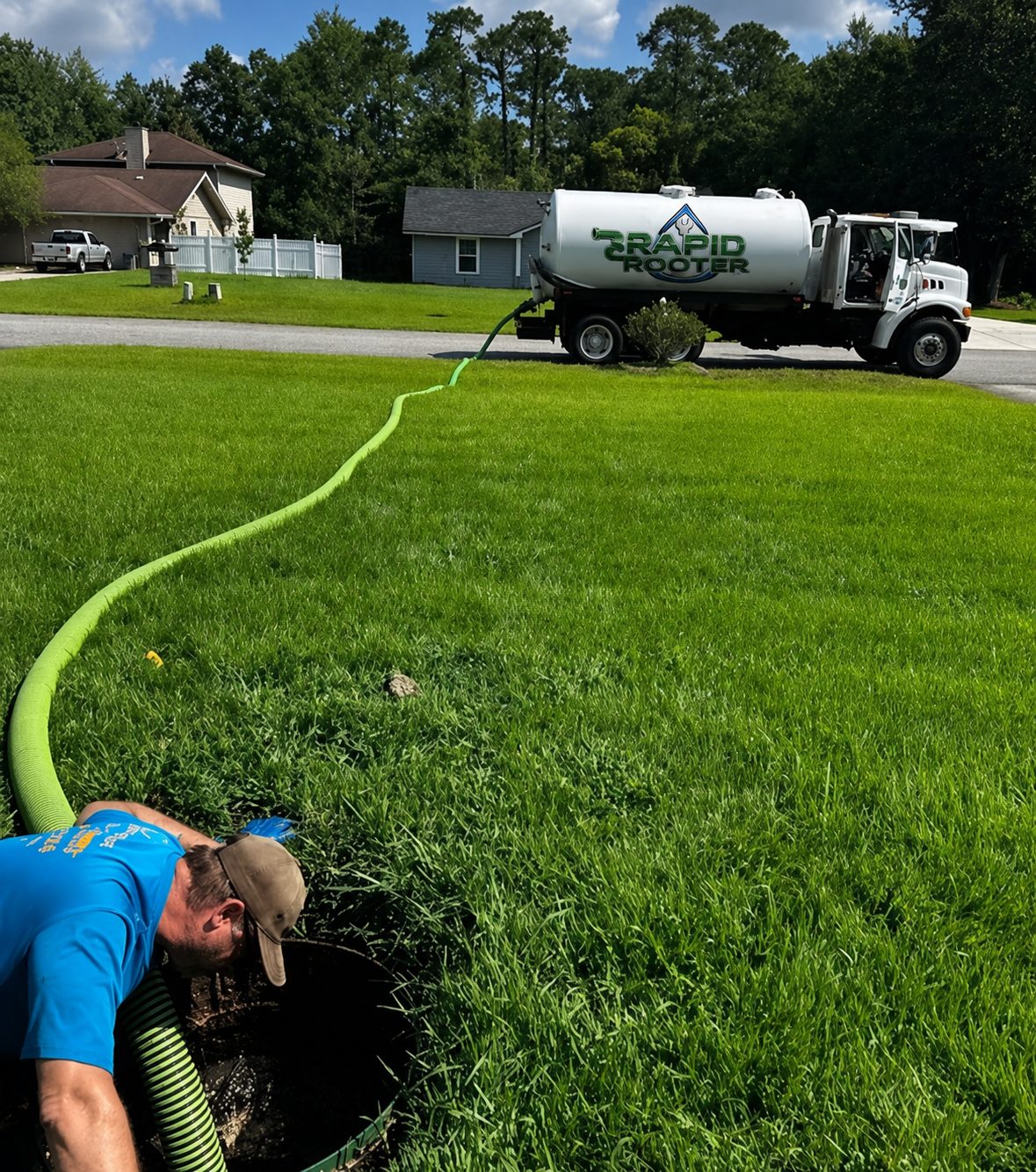
A proper visit is more than emptying a tank. The crew locates and opens the lids, pumps the full contents, and — while the tank is open — looks at the parts you can never see otherwise: the baffles that keep solids where they belong, the filter if your system has one, and the general condition of the tank itself. Pumping day is the cheapest possible day to catch a failing baffle, because the discovery costs nothing extra.
Most standard pump-outs take about an hour. A good crew positions the truck on the street or driveway, runs hose to the tank, protects the route, and leaves the yard the way they found it.
Quick answers
Can I just wait until there's a problem to pump?
You can, but you're gambling with the wrong component. By the time a full tank causes symptoms, solids may already be washing into the drain field — and drain field damage costs many times what years of routine pumping would have. Pumping on schedule is the cheapest insurance a septic owner can buy.
Do septic additives mean I can pump less often?
No. Additives can't remove solids — only pumping does that. NC health authorities don't recognize any additive as a substitute for pumping, and some products can actually harm the bacterial balance or the drain field.
How do I find out when my tank was last pumped?
Check with your county environmental health office — septic permits and some service records are on file — or look for a receipt from the previous owner in your closing documents. If the trail is cold, an inspection can read the sludge level directly and tell you where you stand.
How much does pumping cost in the Charlotte area?
It depends on tank size, how deep the lids are buried, and the distance the hose has to run — which is why we quote before we start rather than publishing a number that's wrong for half the homes that call. What we can promise: no mystery pricing, and no surprise work.
Dealing with this right now? Start with our pumping service page — or skip straight to the form below.