

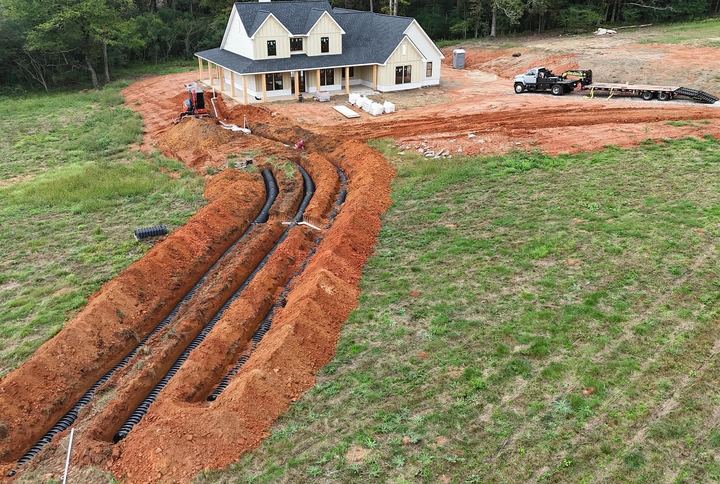
A wet patch in the yard after a Carolina thunderstorm tells you nothing — everything's wet. That same patch in the middle of an August dry spell tells you almost everything. When the sky hasn't delivered water for two weeks and the ground over your septic field is soft, spongy, or green-striped anyway, the water is coming from below. That's effluent surfacing — and paradoxically, the dry season that reveals it is also the best possible time to deal with it.
Why dry weather is the honest season
In winter and spring, a struggling drain field hides in the general dampness. In a dry summer there's no cover story: soil moisture that persists over the field when everything around it is baked means the field is receiving more water than it can pass downward — so it's sending some of it up instead. The same goes for the classic stripe of suspiciously lush, dark-green grass tracing a line across a browning lawn. Something is feeding that stripe, and it isn't rain.
What surfacing effluent actually means
It means the field is overloaded — but not necessarily that the field is dead, and that distinction is worth thousands of dollars. In our experience the causes sort into two families. Upstream problems drowning a healthy field: a tank overdue for pumping passing solids into the lines, a failed baffle doing the same, a cracked or tilted distribution box dumping the entire flow into one trench, or even a running toilet quietly doubling the system's daily load. And genuine field problems: lines crushed by vehicles or invaded by roots, or a field biologically clogged after decades of service.
The first family is fixable for a fraction of replacement cost. The second sometimes is too — sectional repairs exist. Replacement is the last answer, not the first one.
What to do (and not do) this week
While you're getting it diagnosed:
- Keep kids and pets off the wet area — surfacing effluent is sewage, however clear it looks.
- Cut water use where you can: spread laundry out, fix running toilets, shorten showers.
- Don't mow the soggy zone — compaction makes surfacing worse.
- Don't park anything on or near the field. Ever, honestly, but especially now.
- Note what you observe and when — a photo record of where and when it's wet genuinely helps the diagnosis.
Why acting in the dry season pays
Every practical thing about drain field work is easier when the ground is dry: diagnosis is cleaner because any moisture found is meaningful, excavation is kinder to the yard, and if county environmental health permits come into play for the repair, you want that clock running now — not in the November wet season. A drain field caught at the 'soggy stripe' stage has options. One that's been surfacing through two more storm seasons usually has fewer. The gap between those two conversations is the cost of waiting.
Quick answers
The wet spot comes and goes. Does that mean it's fine?
It means the field is on the edge — surfacing when load or ground moisture peaks, recovering when they drop. That's genuinely better news than a permanently soggy field, but the trend only goes one direction without a fix. Intermittent is the early-warning stage; it's the cheapest one to act in.
Could the wet spot be a broken water line instead of septic?
It happens — a supply-line leak also makes a mysterious wet patch. The tells: supply leaks often stay truly clear and odorless and may nudge your water bill, while effluent tends to carry odor and feeds that lush green growth. Part of a proper diagnosis is confirming which water you're looking at before anyone digs.
Do I need a permit to repair a drain field in North Carolina?
Significant drain field work typically runs through your county's environmental health office — Mecklenburg, Union, Cabarrus, Iredell, or Gaston depending on where you live. We're familiar with the local process and handle it as part of the job, not as your homework.
How much does drain field repair cost?
The honest answer is that the diagnosis decides it — a distribution-box fix, a sectional line repair, and a full replacement are wildly different jobs. That's exactly why we diagnose first and show you the evidence before quoting. Beware anyone who prices a field over the phone.
Dealing with this right now? Start with our drain field service page — or skip straight to the form below.